Amarres/ Amuletos
2024
ENGLISH The act of wrapping stones in cotton threads dyed with plants—which are used for their symbolic properties in therapies to cure cultural ailments (such as “air sickness” and “fright sickness”)—reflects, on the one hand, an interest in creating a drawing that unfolds over time, adapting to a three-dimensional form, crossing paths, tracing routes, and forming knots upon itself. But this work, which uses thread to capture the essence of a forest threatened by the fires that ravage it year after year, results in an amulet; through the manual gesture, it fosters connections between the natural and symbolic worlds via the language of art. The plants used to make these natural dyes—brazilwood (Paubrasilia echinata), marigold (Tagetes erecta), muicle (Justicia spicigera), and huizache (Acacia farnesiana)—are plants that are used in Mexico for their therapeutic and ritual properties.
ESPAÑOL La acción de rodear las piedras con hilos de algodón teñidos con plantas -que se utilizan por sus cualidades simbólicas en terapias para curar males culturales (mal de aire, mal del susto)-, corresponde por una parte al interés de elaborar un dibujo que se desenvuelve en el tiempo, que se adapta a una forma tridimensional, cruzando caminos, haciendo rutas y nudos sobre ella misma. Pero esta acción, que contiene mediante el hilo la materialidad de un bosque amenazado por los incendios que lo atacan año con año da como resultado un amuleto; mediante el gesto manual que propicia entrelazamientos desde el mundo natural y el simbólico a través del lenguaje artístico. Las plantas con las que fueron elaborados los tintes naturales son: palo de Brasil (Paubrasilia echinata), cempasúchil (Tagetes erecta), muicle (justicia spicigera) y huizache (acacia farnesiana), plantas que se utilizan por sus propiedades terapéuticas y rituales en México.
Despedida
obsidian stone, cotton thread dyed with brazilwood (paubrasilia echinata)
11.4 X 8.6 X 5.1 in.
piedra de obsidiana, hilo de algodón teñido con palo brasil (paubrasilia echinata)
29 X 22 X 13 cm.

From series / de la serie "Matrices efluvios y deseos", 2024 front view / vista frente

From series / de la serie "Matrices efluvios y deseos", 2024 lateral right view / vista lateral derecha

From series / de la serie "Matrices efluvios y deseos", 2024 lateral left view / vista lateral izquierda
From series / de la serie "Matrices efluvios y deseos", 2024 front view / vista frente
Amarre
obsidian stone, cotton thread dyed with muicle (Justicia spicigera)
3.5 X 3.9 X 2 in.
piedra de obsidiana, hilo de algodón teñido con muicle (Justicia spicigera)
9 X 10 X 5.3 cm.
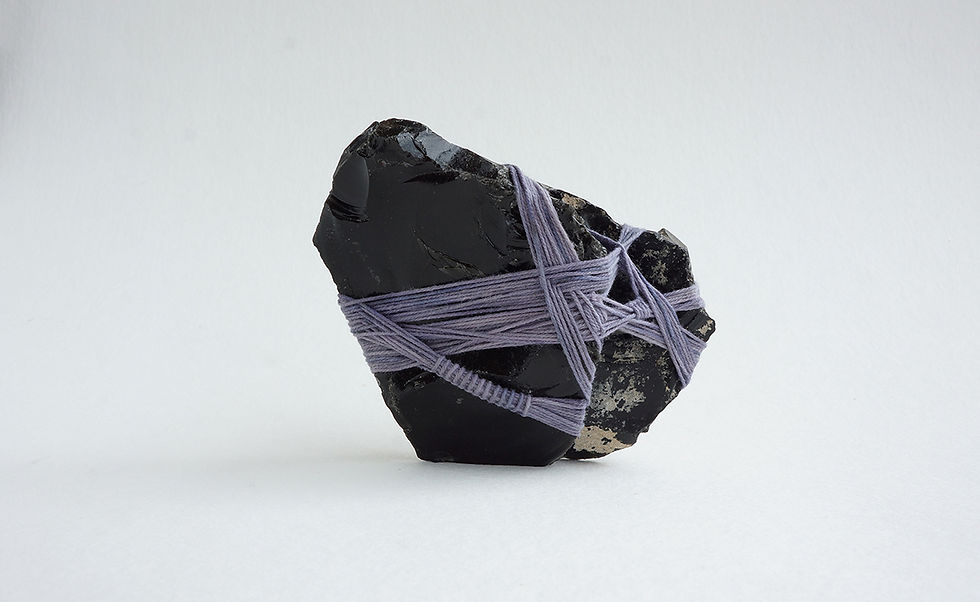
From series / de la serie "Matrices efluvios y deseos", 2024 front view / vista frente

From series / de la serie "Matrices efluvios y deseos", 2024 lateral left view / vista lateral izquierda
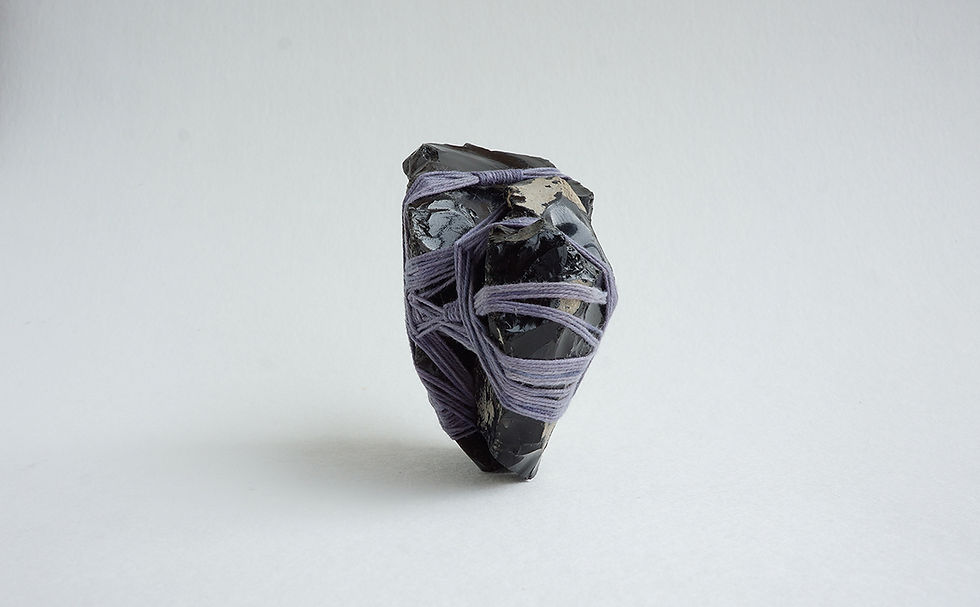
From series / de la serie "Matrices efluvios y deseos", 2024 lateral right view / vista lateral derecha
From series / de la serie "Matrices efluvios y deseos", 2024 front view / vista frente
Obsidiana roja
obsidian stone, cotton thread dyed with with brazilwood (Paubrasilia echinata)
4.3 X 2.3 X 2.3 in.
piedra de obsidiana, hilo de algodón teñido con palo brasil (Paubrasilia echinata)
11 X 6 X 6 cm.

From series / de la serie "Matrices efluvios y deseos", 2024 front view / vista frente

From series / de la serie "Matrices efluvios y deseos", 2024 lateral right view / vista lateral derecha

From series / de la serie "Matrices efluvios y deseos", 2024 lateral left view / vista lateral izquierda
From series / de la serie "Matrices efluvios y deseos", 2024 front view / vista frente
Abrazo al sur
obsidian stone, cotton thread dyed with with marigold (Tagetes erecta)
2.3 X 2.5 X 1.9 in.
piedra de obsidiana, hilo de algodón teñido con cempasúchil (Tagetes erecta)
6 X 6.5 X 5 cm.

From series / de la serie "Matrices efluvios y deseos", 2024 front view / vista frente

From series / de la serie "Matrices efluvios y deseos", 2024 lateral richt view / vista lateral derecha

From series / de la serie "Matrices efluvios y deseos", 2024 lateral left view / vista lateral izquierda
From series / de la serie "Matrices efluvios y deseos", 2024 front view / vista frente
Menos que, más que
red stone, cotton thread dyed with with Huizache (Vaquellia farnesiana) and ojo de venado (Mucuna urens)
1.5 X 3.7 X 2.5 in.
piedra roja, hilo de algodón teñido con Huizache (Vaquellia farnesiana) y ojo de venado (Mucuna urens)
4 X 9.5 X 6.5 cm.

From series / de la serie "Matrices efluvios y deseos", 2024 front view / vista frente

From series / de la serie "Matrices efluvios y deseos", 2024 lateral right view / vista lateral derecha

From series / de la serie "Matrices efluvios y deseos", 2024 lateral left view / vista lateral izquierda
From series / de la serie "Matrices efluvios y deseos", 2024 front view / vista frente
Roja muicle
red stone, ixtle thread dyed with with muicle (Justicia spicigera)
2.7 X 3 X 2.4 in.
piedra roja, hilo de ixtle teñido con muicle (Justicia spicigera)
7 X 7.7 X 6.3 cm.

From series / de la serie "Matrices efluvios y deseos", 2024 front view / vista frente

From series / de la serie "Matrices efluvios y deseos", 2024 lateral right view / vista lateral derecha

From series / de la serie "Matrices efluvios y deseos", 2024 lateral left view / vista lateral izquierda
From series / de la serie "Matrices efluvios y deseos", 2024 front view / vista frente
Arquitecturas inciertas Part of the project / parte del proyecto Matrices, efluvios y deseos, 2024 ENGLISH The project began with an interest in working with Bosque de la Primavera as a territory that initially caught my attention due to its geological characteristics and later due to several encounters that revealed the symbolic, magical, and emotional relationship that visitors have with it. Reflecting on its geological and environmental characteristics, such as the hot water that flows through the river, the vapors that emanate from it, and the fires that occur every year during the dry season, I analyzed how these atmospheric phenomena, which are capricious and unpredictable—smoke, steam, exhalations, or storms—are visually presented. These conditions made me think of the ethereal, the ephemeral, and the volatile as manifestations to be investigated from an ethnobotanical perspective that establishes an interface between culture and nature. The pieces created for this project respond to the experience of diving in the Bosque de la Primavera at Zapopan, Jalisco, México, as an approach to capturing the dialogue with the place and with the symbolic dynamics we perform within it. They are devices that function as ritual gestures that materialize and manifest some of the singularities of loss: its prevention and the restoration of affective and ecosystemic relationships. They are a kind of amulet that uses plant materials to represent these ecosystem interactions. ESPAÑOL El proyecto dio inicio por el interés de trabajar con el Bosque de la Primavera como territorio en el que en un primer acercamiento me llamó la atención por sus características geológicas y posteriormente por algunos encuentros que evidenciaban la relación simbólica, mágica y afectiva que los visitantes mantienen con él. A partir de reflexionar en sus características geológicas y medioambientales como el agua caliente que corre por el río, los vapores que emana y los incendios que hay cada año en la estación seca, analicé cómo es que se presentan visualmente esos fenómenos de carácter atmosférico que son caprichosos e imprevisibles: el humo, vapor, exhalaciones o tormentas. Estas condiciones me hicieron pensar en lo etéreo, lo efímero y volátil como manifestaciones a investigar desde la perspectiva etnobotánica que establece una interfaz entre la cultura y la naturaleza. Las piezas elaboradas para este proyecto responden a la experiencia vivida en las inmersiones dentro del Bosque de la Primavera en Zapopan, Jalisco, México, como un acercamiento para capturar el diálogo con el lugar y con las dinámicas simbólicas que realizamos dentro de él. Son dispositivos que funcionan como gestos rituales que se materializan y que manifiestan algunas de las singularidades de la pérdida: su prevención y la restauración de relaciones afectivas y ecosistémicas. Son una especie de amuletos que utilizan materiales vegetales y plásticos para representar estas interacciones ecosistémicas.
This project was part of the artistic residency at / este proyecto fue parte de la residencia artística en
Laboratorio de creación contemporánea
Universidad Tecnológico de Monterrey, Campus Guadalajara, México
%20(1).png)
